
Why SecOps Teams Are Overloaded—and How Better Data and Automation Fix It
Updated: May 7
Security Operations (SecOps) teams are not failing because they lack tools.They’re failing because they are drowning in data, disconnected workflows, and operational complexity.
Every day, organizations ingest:
Thousands of vulnerability findings
Endless alerts from SIEM, EDR, and scanners
Disconnected CMDB and asset data
Manual processes that do not scale
The result is operational overload.
Instead of proactively reducing cyber risk, teams spend their time reacting—closing tickets, silencing alerts, and trying to answer one critical question:
What actually matters most to the business?
The Reality of Today’s Security Operations Challenges
Modern security environments generate more data than most teams can realistically process. Without context, prioritization, and automation, security operations become reactive, fragmented, and inefficient.
The Biggest Problems Facing SecOps Teams
1. Alert Fatigue
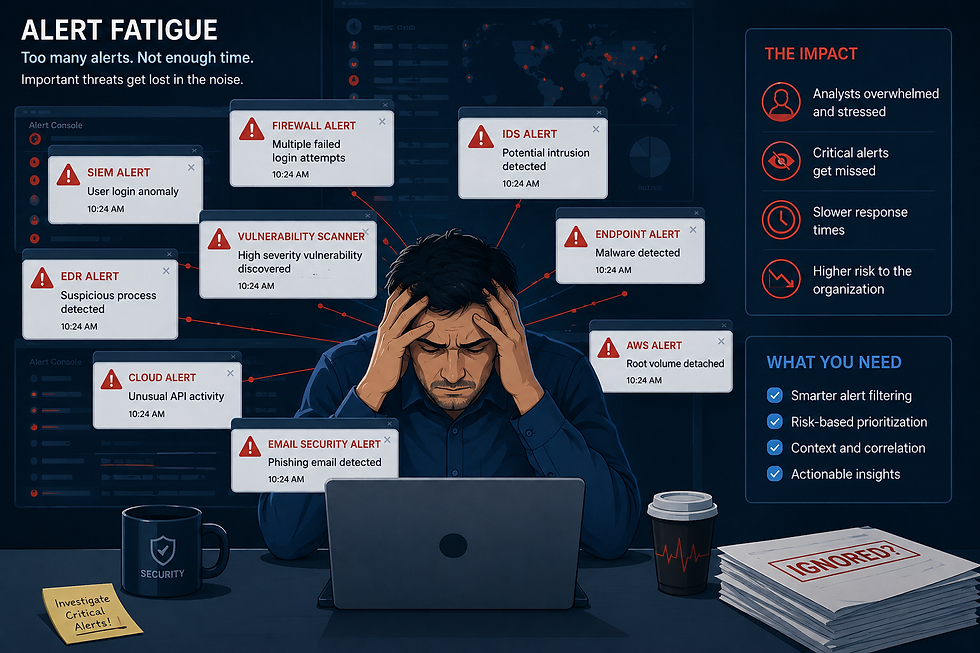
Security analysts are flooded with notifications—many of which are low priority, duplicated, or false positives.
Over time, this creates:
Analyst burnout
Slower investigations
Missed critical threats
Reduced operational effectiveness
When everything looks urgent, truly dangerous threats become harder to identify.
2. Vulnerability Backlogs That Never Shrink

Many organizations have thousands—or even hundreds of thousands—of open vulnerabilities.
The problem is not visibility.The problem is prioritization.
Traditional approaches rely heavily on CVSS scores alone, which often fail to reflect:
Business criticality
Real-world exploitability
Service impact
Operational risk
This leaves teams chasing numbers instead of reducing meaningful risk.
3. Poor Asset & CMDB Visibility

If your CMDB is incomplete or not aligned to a service model like CSDM, your organization lacks true operational visibility.
You may not know:
Which systems support critical business services
Which vulnerabilities impact revenue-generating applications
Who owns affected infrastructure
Where your highest operational risk exists
Without accurate relationships between assets, applications, and business services, security teams operate blindly.
4. Fragmented Manual Processes

Many organizations still rely on:
Spreadsheets
Email approvals
Manual ticket routing
Multiple disconnected tools
These “swivel-chair” operations slow remediation, increase human error, and create inconsistent workflows.
Security teams cannot scale effectively with manual processes.
5. Metrics That Don’t Measure Risk

Many organizations still measure success by:
Tickets closed
Vulnerabilities scanned
Alerts generated
These metrics track activity—not outcomes.
Mature SecOps programs focus on metrics that reflect actual business risk reduction.
Examples include:
Mean Time to Remediate (MTTR)
SLA compliance
Risk reduction trends
Critical service exposure
Remediation effectiveness
The Root Cause: Lack of Context
Here is the real issue:
Most SecOps programs are tool-driven instead of risk-driven.
Security tools generate massive amounts of data.But without business context, data becomes noise.
What many organizations are missing:
Business service mapping
Asset criticality
Ownership accountability
Integrated workflows
Risk-based prioritization
Without context, every vulnerability appears equally important.
And when everything is treated as critical, nothing truly is.

How to Build a Smarter SecOps Model
Fixing security operations is not about buying another security tool.
It is about redesigning how security operations function.
1. Make Security Service-Aware
Modern security operations must connect:
Vulnerabilities → Assets → Business Services
This is where platforms like ServiceNow become powerful operational enablers.
When the CMDB aligns with the Common Service Data Model (CSDM), organizations gain the ability to:
Prioritize vulnerabilities by business impact
Identify crown-jewel services
Understand operational dependencies
Reduce risk intelligently
Instead of reacting to thousands of alerts, teams focus on the vulnerabilities that threaten critical operations.
2. Shift to Risk-Based Prioritization
CVSS scores alone are no longer enough.
Modern prioritization models should consider:
Asset criticality
Threat intelligence
Exploitability
Internet exposure
Business service impact
This dramatically reduces noise and helps teams focus remediation efforts where they matter most.
3. Automate the Right Processes
Automation should eliminate repetitive operational tasks—not create more complexity.
High-value automation opportunities include:
Auto-assignment workflows
SLA-driven remediation tracking
Threat intelligence enrichment
Risk acceptance workflows
Automated reporting and notifications
Well-designed automation can reduce manual effort by 70–90% while improving response consistency.
4. Fix the CMDB Foundation
Your CMDB is either:
A strategic operational asset
Or a major operational liability
To support effective SecOps, the CMDB must:
Be continuously governed
Align with CSDM
Maintain accurate service relationships
Include ownership and dependency mapping
Without a trusted CMDB foundation, security prioritization breaks down.
5. Measure Outcomes, Not Activity
Mature SecOps organizations focus on measurable risk reduction.
Key metrics include:
MTTR (Mean Time to Remediate)
Reduction in critical exposure
SLA compliance by severity
Vulnerabilities impacting critical services
Remediation trend analysis
This changes executive conversations from:
“How many tickets did we close?”
To:
“How much business risk did we reduce?”
What Mature SecOps Looks Like
Organizations that modernize their operations typically achieve:
50–80% reduction in vulnerability backlog
Faster remediation of critical threats
Better operational visibility
Improved collaboration between security and IT
Stronger alignment with business priorities
Most importantly, security operations become proactive instead of reactive.
Where Organizations Commonly Struggle
Even with the right strategy, many organizations face challenges with:
CMDB ownership and governance
Mapping business services
Integrating tools into unified workflows
Defining risk-based prioritization models
Establishing automation standards
This is where operational experience and strategic guidance make the difference.
How We Help Organizations Modernize SecOps
We help organizations transform overwhelmed security operations into efficient, risk-driven programs by:
Aligning CMDB environments to CSDM
Implementing ServiceNow Vulnerability Response workflows
Designing risk-based prioritization models
Automating remediation and reporting
Improving operational governance
Establishing continuous improvement programs
Final Thoughts
Security Operations is not broken.
It is operating without the business context required to make intelligent decisions.
When organizations improve visibility, automate workflows, align CMDB data, and prioritize risk intelligently, security operations become dramatically more effective.
The future of SecOps is not about more alerts.
It is about smarter operations.
Ready to Improve Your Security Operations?
Whether you are struggling with vulnerability overload, CMDB visibility, or inefficient remediation workflows, the right operational model can dramatically improve your security posture and reduce business risk.
Now is the time to transform SecOps from reactive firefighting into a strategic business capability.



Comments